
Central Oklahoma hydroseeding
Hydroseeding in Oklahoma City, OK
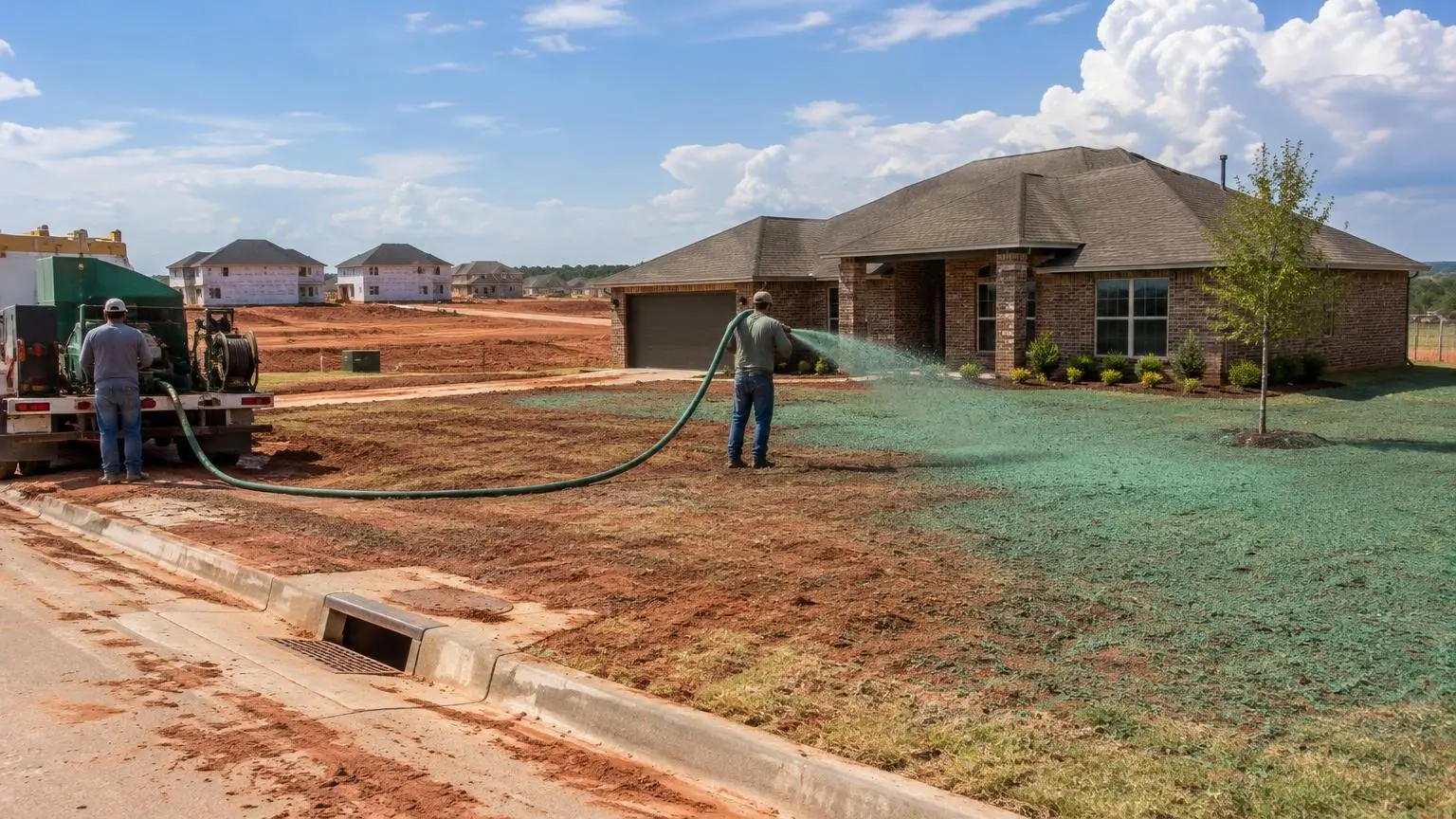
Seed, mulch and erosion control sprayed onto red dirt before the next spring storm can move it.
- Site visit and written quote at no charge
- Seed blend picked for the season: Bermuda in summer, fescue in fall
- Silt fence and inlet protection set before the first rain, not after
Getting Grass to Hold on Central Oklahoma Ground
Hydroseeding in Oklahoma City is mostly a race against two things: summer heat and spring rain. Our truck mixes grass seed with wood fiber mulch, fertilizer and a tackifier in water and sprays it over prepared soil in one pass, so the seed sits under a moist, sticky blanket instead of on bare dirt. That blanket matters here. The city gets about 36 inches of precipitation a year, much of it in hard spring storms, and it also sees long dry spells. A hydroseed lawn gives new grass a better start in both. We work for homeowners with a new or torn-up yard, builders who need lots finished and stabilized, and site contractors who need disturbed ground covered.
Why the dirt here is red
Oklahoma's state soil, Port silt loam, takes its reddish color from weathered Permian sandstone, siltstone and shale, and it covers around a million acres in 33 of the state's 77 counties. The USDA describes Port as a deep, well-drained flood plain soil that formed in calcareous loamy alluvium, with a subsoil that turns moderately alkaline and carries visible lime. It also floods for brief periods between March and October. Upland yards across the metro sit on different red soils, many of them tighter and more clay-rich, and builder lots often have the topsoil scraped off entirely. We look at what is actually in your yard before choosing prep, topsoil and fertilizer. A soil test helps, and Oklahoma State University Extension suggests pulling one about two months before planting so there is time to act on it.
Hills, oaks and a river through the middle
The city sits in the Sandstone Hills region, a belt of low hills known for post oak and blackjack oak, and its northeast side runs into the Cross Timbers. A yard on a wooded hillside in the northeast part of town has very different needs from a flat lot on old bottomland near the Oklahoma River, which is what the North Canadian is called inside city limits. Hillside yards shed water fast and need heavier mulch or blankets. Shaded lots under big oaks often cannot hold Bermuda at all. Flat lots can pond after a storm and need grading before seed. We price and plan each of those differently.
Comparing sod, hydroseed and dry seed
Rolled sod is a lawn on the day it goes in, which makes it the right call for a small area that has to look done right away. It is also the most expensive option by a wide margin; HomeGuide's installed range for sod runs $1 to $4 per square foot. The cheapest route is dry seed spread by hand or with a drop spreader, but on a slope or in a windy, sunny yard much of it washes off, blows away or dries out before it roots. Hydroseeding sits between them on cost and does well where the other two struggle: large yards, slopes, odd shapes and long strips along drives and fences. OSU Extension specifically calls hydroseeding very effective for hard-to-plant areas such as slopes. The trade-off is time and water. Expect several weeks of steady watering and about a month or more before the first mow, not an instant lawn.
When to seed in Oklahoma City
The calendar decides more than anything else. Bermuda, buffalograss and zoysia are warm-season grasses that need warm soil to germinate. OSU Extension says that in Oklahoma that usually means not seeding them before May 1, and getting most seeded Bermuda in by July 1 so it has time to root before winter. Tall fescue is a cool-season grass, and its ideal window is late September through October, with March as a second choice. That leaves a gap from November through April when most seed does poorly. During that gap we can still stabilize bare ground with hydromulch, blankets or a temporary cover, then come back for the permanent seeding when the window opens.
Heat and watering
The city reaches 90 degrees on nearly 70 days a year and 100 degrees on about ten. A freshly sprayed lawn in July can dry out in an afternoon if nobody waters it. OSU Extension advises keeping the top inch of a new seedbed moist with light daily watering for at least 10 to 14 days. With hydroseed the seed sits right at the surface, so short, frequent watering is the whole game until it roots. Once the grass is up and filling in, longer and less frequent watering pushes roots deeper. We leave written watering steps for the grass you chose and the month we sprayed it.
What goes in the tank
The slurry is mostly water. Into it go grass seed, a fiber mulch made from wood or paper, starter fertilizer and a tackifier that glues the mix to the soil. A green dye shows where the hose has already covered, which is why a fresh hydroseed lawn looks bright green before anything has sprouted. For slopes we raise the mulch rate or switch to a bonded fiber matrix, which dries into a tougher, continuous layer. On a flat backyard, a lighter mix is enough. The blend changes with the job, and we list it on the estimate so you know what is going down.
Storms, mud and stormwater rules
The severe weather season peaks in April and May, which is also when many builders want lots finished. Bare graded soil in a downpour turns into red mud in the gutter and the storm drain. Oklahoma's Department of Environmental Quality requires an OKR10 construction stormwater permit, with a stormwater pollution prevention plan, whenever a project disturbs one acre or more. Smaller disturbances need it too when they sit inside a bigger planned development. DEQ also notes that cities and counties may require their own permit coverage. Our erosion control services fit inside that plan: silt fence installation, inlet protection, hydromulch and erosion control blankets on slopes and swales, then final seeding to stabilize the site.
What we do
- New lawn installation by hydroseed, from small backyards to multi-acre lots
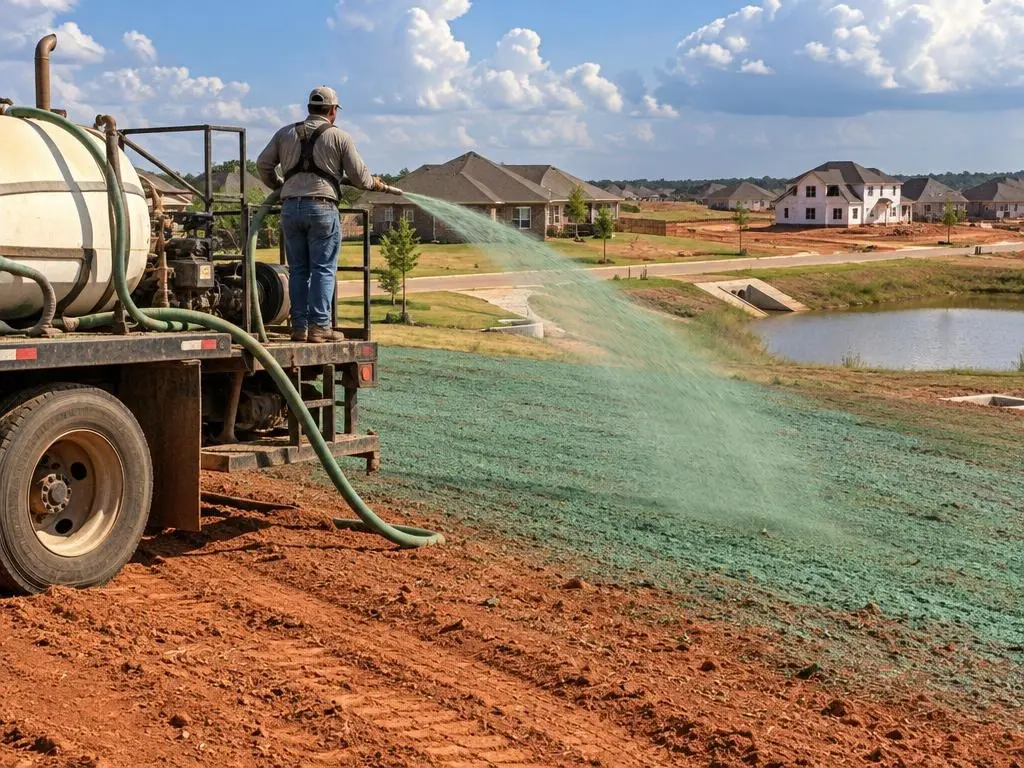
- Commercial and construction hydroseeding for builders and site contractors
- Slope stabilization: hydromulch on gentle grades, bonded fiber matrix or blankets on steep ones
- Silt fence, inlet protection and other sediment control
- Dirt work ahead of seed: yard and land grading, topsoil, plus excavation and trenching for drainage
- Lawn repair, lawn renovation and overseeding of thin turf
Phone (405) 529-7119 or use the form, and we will meet you on site to look at the ground together.
Our Services
Six kinds of work, all aimed at getting bare Central Oklahoma dirt covered and growing.
New Lawn Hydroseeding
A hydroseed lawn sprayed onto prepared soil, with Bermuda or fescue timed to the season.
Learn more →Builder & Commercial Hydroseeding
Final stabilization and turf for subdivisions, commercial pads, detention ponds and right-of-way.
Learn more →Slope & Erosion Control
Sprayed hydromulch, bonded fiber matrix and straw or coir blankets to hold slopes, swales and ditches.
Learn more →Silt Fence & Sediment Control
Silt fence, inlet protection and perimeter controls that keep mud off streets and out of storm drains.
Learn more →Grading, Topsoil & Dirt Work
Yard grading, land grading and topsoil that give seed a smooth, well-drained bed.
Learn more →Lawn Repair & Overseeding
Thin, patchy or storm-damaged lawns brought back with overseeding or a full lawn renovation.
Learn more →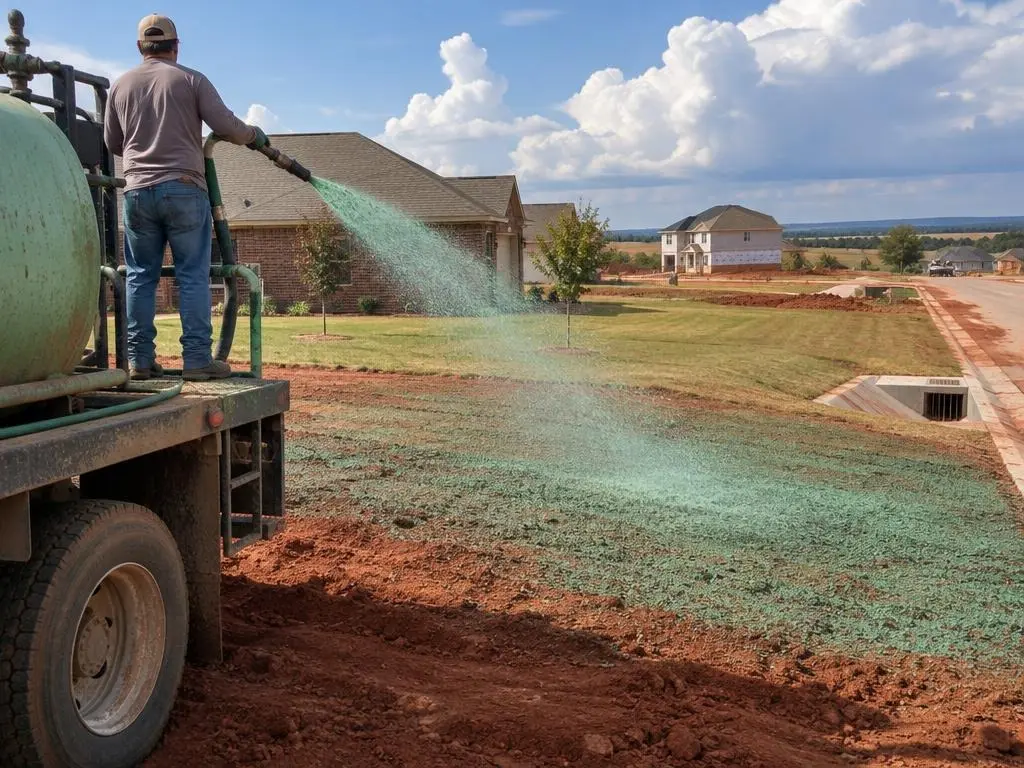
Towns Around the Metro We Cover
We work across Oklahoma City and the towns that ring it. To the north, Edmond, Guthrie, Piedmont, Nichols Hills, Warr Acres and Bethany range from older, tree-shaded neighborhoods to new subdivisions cut into rolling, wooded ground. South of the river, Moore, Norman, Newcastle, Noble, Blanchard and Tuttle are adding homes fast on former farm and ranch land, much of it near the Canadian River. On the east side, Midwest City, Del City, Choctaw and Harrah mix post-war neighborhoods with larger rural lots, while Yukon, Mustang and El Reno spread west onto open, flatter prairie. The town pages go into the soil, slopes and water in each place, so you get a sense of how we would handle your lot before we come out.
- Hydroseeding in Oklahoma City, OK
- Hydroseeding in Edmond, OK
- Hydroseeding in Norman, OK
- Hydroseeding in Moore, OK
- Hydroseeding in Midwest City, OK
- Hydroseeding in Del City, OK
- Hydroseeding in Yukon, OK
- Hydroseeding in Mustang, OK
- Hydroseeding in Bethany, OK
- Hydroseeding in Choctaw, OK
- Hydroseeding in Piedmont, OK
- Hydroseeding in Newcastle, OK
- Hydroseeding in Blanchard, OK
- Hydroseeding in Tuttle, OK
- Hydroseeding in Guthrie, OK
- Hydroseeding in Harrah, OK
- Hydroseeding in El Reno, OK
- Hydroseeding in Noble, OK
- Hydroseeding in Nichols Hills, OK
- Hydroseeding in Warr Acres, OK
Why Homeowners Call Hydroseeding Oklahoma City
Seed matched to the month
We will not spray Bermuda in October or fescue in July. If the calendar is wrong for seed, we offer mulch or a temporary cover until it is right.
Mud stays on the lot
Where a lot drains toward a street or creek, we set silt fence and inlet protection ahead of grading and leave them until the grass holds.
Prep is in the price
Ripping compacted pads, adding topsoil and fine grading are listed on the estimate, not added after we arrive.
One crew from dirt to grass
Grading, topsoil, seeding and erosion control are handled by the same people, so nothing falls between two contractors.
Common Questions
How much does hydroseeding cost in central Oklahoma?
Published national guides range from about $0.06 to $0.35 a square foot for residential hydroseeding, varying by source. HomeGuide's figure for a 5,000-square-foot yard is $1,000 to $1,750. LawnStarter notes that many companies charge a minimum job fee of $300 to $500. Slopes, heavy prep and topsoil push the cost up. Once we have walked your yard, the total we put in writing is the one you are billed.
What type of grass seed is best for Oklahoma?
For sunny yards, Bermuda is the usual choice; OSU Extension lists Bermuda, buffalograss and zoysia as the warm-season grasses most often planted in the state. Buffalograss suits low-water areas and is better adapted to western Oklahoma. For shaded yards under large trees, tall fescue is the common pick because the warm-season grasses cannot handle shade.
When should you overseed in Oklahoma?
It depends on what you are overseeding with. Tall fescue and other cool-season seed go down in late September and October, with March as a second choice. Thin Bermuda is better repaired with Bermuda seed from May into early summer, once the soil is warm.
Is hydroseeding cheaper than sod?
Usually, and by a wide margin. HomeGuide's installed sod range is $1 to $4 per square foot; its hydroseeding range is $0.12 to $0.35. Sod finishes faster, though, so it can still be worth it for a small patch that has to look done right away.
When will a new hydroseed lawn in Oklahoma City be ready to mow?
Seed often starts to show within about a week in warm weather, and HomeGuide puts the first mowing at four to six weeks. Bermuda sprayed in late May or June usually gets there faster than seed sprayed at the edge of the season.
Can you hydroseed in winter in Oklahoma City?
Not for a permanent lawn. Warm-season seed needs warm soil and fescue does poorly once November turns cold. In winter we can still spray hydromulch or a temporary cover to hold bare ground, then seed when the window opens.
Do I need a stormwater permit before grading my lot?
Oklahoma DEQ requires OKR10 coverage and a stormwater pollution prevention plan when a project disturbs at least an acre, or when a smaller piece belongs to a bigger development that crosses an acre. The city or county may require its own permit too. A single backyard regrade usually falls well under that, but we still keep mud out of the street.
Have Us Look at Your Bare Ground
We walk the site and write up a quote free of charge, in Oklahoma City and nearby towns.